Introduction:
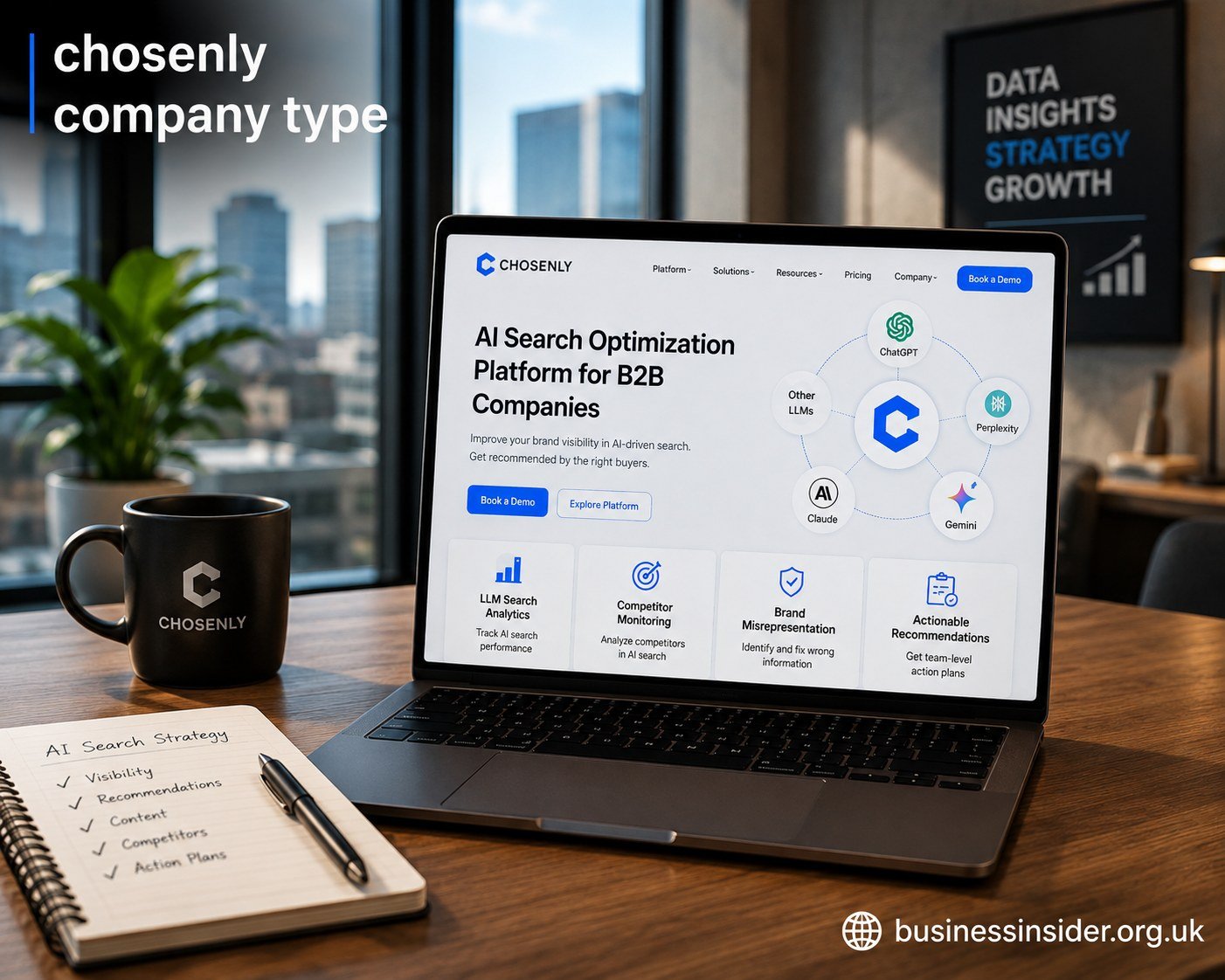
If you have searched for Chosenly company type, you may have noticed that basic company descriptions do not tell the whole story. Chosenly operates in a newer corner of business technology where artificial intelligence is changing how buyers discover software. The company works with B2B companies that want their brands to appear more often when potential customers ask AI tools for recommendations.
That approach gives marketing teams a different way to think about AI search visibility. Rather than chasing every possible mention, businesses can focus on searches that influence real purchasing decisions. Chosenly is therefore best understood as a privately held B2B SaaS company with a specialized AI-search focus. Understanding its structure, services, business model, and market position can help you decide whether the platform fits your marketing strategy.
Chosenly is a privately held software company focused on B2B artificial intelligence search. Its legal terms identify the business as Chosenly LLC. LinkedIn currently classifies Chosenly as a privately held software development company.
More specifically, Chosenly operates as a B2B SaaS business. Its platform helps companies understand how large language models describe and recommend their brands. That focus puts Chosenly inside the fast-growing field of AI Search Optimization and Generative Engine Optimization.
The important distinction is simple. Chosenly Company Type is not merely another SEO dashboard. It aims to help businesses influence how AI systems discover, understand, compare, and recommend them. That makes its business model particularly interesting for companies selling complex products.
Chosenly – Company Profile
Understanding What Is Chosenly Company Type starts with its basic corporate identity. Chosenly LLC operates a SaaS platform designed for B2B companies that want stronger visibility across ChatGPT and other LLM platforms. LinkedIn currently lists the company as privately held and places it within software development.
Its commercial focus sits between marketing technology, SEO technology, and artificial intelligence. The company describes its product as an AISO platform for B2B buyers. Its website emphasizes AI search visibility, recommendations, misinformation, and revenue-focused actions rather than traditional keyword rankings.
| Company detail | Current information |
| Legal name | Chosenly LLC |
| Company type | Privately held |
| Industry | Software development |
| Business model | B2B SaaS |
| Main focus | AI Search Optimization and GEO |
| Primary customers | B2B companies and agencies |
| Core channels | ChatGPT and other LLMs |
| Main commercial goal | AI visibility and pipeline generation |
What Is Chosenly and What Does the Company Do?
So what does Chosenly actually do? It helps companies optimize brand presence in LLMs where potential customers increasingly research vendors. Instead of asking only whether a website ranks on Google, Chosenly asks whether AI systems recommend that business when buyers describe a problem.
That distinction matters because modern buyers can ask ChatGPT for several vendors before visiting any website. Chosenly studies bottom-of-funnel prompts and high-intent search queries that can influence those decisions. Its platform then connects visibility gaps with actions that marketing teams can actually pursue.
For example, imagine a U.S. finance company selling compliance software. A buyer might ask an AI system to recommend three reliable platforms for mid-market banks. Appearing in that answer can matter more than ranking for a broad informational keyword.
Chosenly therefore focuses heavily on LLM recommendations, not simply traffic. Its stated goal is to help businesses earn mentions that can eventually contribute to pipeline generation. That makes the platform especially relevant to sales-led B2B organizations.
Chosenly – About the Company
Chosenly Company Type emerged around a changing problem in digital marketing. Traditional SEO helped companies compete for blue-link search results. AI search introduces another layer where models summarize information and recommend businesses directly.
The company now positions itself as more than an AI visibility tracker. Its LinkedIn profile describes an agentic GEO expert that can support content strategy, mentions, Reddit activity, positioning, and responses to inaccurate AI descriptions.
That broader approach is useful because visibility alone does not solve a marketing problem. A dashboard can tell you that competitors appear more often. It becomes far more valuable when it also explains why that happens and what your team should change.
Chosenly’s own materials emphasize team-level action plans rather than decorative metrics. This approach reflects a larger shift toward practical AI marketing where measurement must eventually lead to execution.
How Does Chosenly Work?
Chosenly begins by examining how AI systems respond to relevant commercial prompts. Its LLM search analytics can reveal where a company appears and where competing vendors receive stronger recommendations.
The platform then moves toward explaining the Chosenly Company Type. Its AI search analytics examine factors such as competitors, citations, positioning, and brand descriptions. This creates a more useful picture than a single visibility percentage.
The workflow can be understood through a simple sequence:
| Stage | Purpose |
| Discover | Find commercially important AI prompts |
| Measure | Assess current AI search visibility |
| Compare | Study competing recommendations |
| Diagnose | Identify positioning and citation gaps |
| Correct | Address inaccurate brand information |
| Execute | Create content and pursue relevant mentions |
| Monitor | Track changes across AI search |
This process also supports AI search performance tracking. Instead of treating AI visibility as a one-time audit, companies can observe how their position changes after making improvements.
Chosenly’s Main Products and Services
Chosenly combines several capabilities inside one platform. Its current pricing page lists analytics, planning, content creation, placement tools, Reddit workflows, positioning analysis, and misinformation features.
Its positioning module can examine how a company performs against different AI evaluation criteria. The misinformation module can identify inaccurate statements and trace their apparent sources. That creates practical opportunities for brand teams and legal departments.
The platform also offers ChatGPT optimization, Perplexity optimization, and Gemini optimization through expanded platform coverage. Current add-ons can extend coverage across platforms, regions, or business units.
For marketing teams, this means the product can sit closer to execution than many conventional analytics tools. It can help connect research with content, outreach, Reddit activity, and public-source corrections.
Chosenly’s Business Model and Revenue Sources
Chosenly follows a subscription-oriented SaaS model with additional consulting and implementation services. Its current pricing page lists a SaaS Platform plus Consulting Support plan and a White Glove Implementation option.
The published SaaS plan includes prompt coverage, outreach contacts, AI-optimized content drafts, Reddit threads, unlimited seats, and dedicated support. The White Glove option adds GEO experts, content writers, outreach specialists, strategy sessions, and implementation work.
This structure resembles other specialized B2B software businesses. The software creates recurring revenue while professional support increases the value for companies without internal GEO specialists.
For buyers comparing B2B software optimization tools, that difference matters. Some platforms primarily sell measurement. Chosenly attempts to combine measurement with practical execution.
Chosenly Company Type Founders and Board of Directors
Public information identifies several people connected with Chosenly, including Udayan Kumar, Harsh Gautam, Ishaan Shakunt, and Rushabh Patel. LinkedIn lists these individuals among the employees associated with the company.
However, readers should separate publicly listed team members from confirmed directors. A formal board of directors should not be assumed simply because executives or founders appear online.
That distinction is important when researching What Is Chosenly Company Type. Early-stage private companies often have limited public corporate disclosures. Their leadership information may appear across company websites, professional profiles, interviews, and legal documents rather than public-company filings.
Chosenly’s Funding and Investors
Funding information requires a cautious approach. Chosenly operates privately, and its public materials do not provide the same detailed investor disclosures found with major public technology companies.
That means readers should avoid repeating unsupported funding totals or investor names. A private company can grow through founder capital, operating revenue, strategic investment, or external fundraising without publishing every detail.
This limited disclosure is not unusual for an early-stage SaaS business. It simply means that funding should not become the basis for judging Chosenly’s product strength.
A better evaluation examines customers, product capabilities, pricing, integrations, growth signals, and measurable outcomes. Those factors provide more useful context for a prospective software purchase.
Chosenly’s Employee Count and Growth Trend
LinkedIn currently displays Chosenly as a company with a 2–10 employee company-size classification while showing 21 discoverable employees. Those figures should not be treated as an audited headcount.
Still, the available information suggests an expanding product scope. Chosenly now covers analytics, content, positioning, placements, Reddit, PR, reviews, and brand misinformation. That breadth indicates an attempt to become a broader GEO execution platform.
Growth should therefore be judged through several signals. Product expansion, new partnerships, service offerings, hiring, customer evidence, and platform coverage can all provide clues.
For users comparing software reviews, this is useful context. A young company can offer innovative capabilities while still developing its processes and product maturity.
Chosenly’s Market Position and Industry Focus
Chosenly Company Type occupies a specialized corner of marketing technology. Its central audience consists of B2B enterprises and other organizations where buyers research complex products through AI systems.
This focus separates it from broad SEO suites. Traditional SEO platforms may cover keywords, backlinks, technical audits, rankings, and traffic. Chosenly concentrates more directly on AI-generated recommendations and the information behind those recommendations.
Its homepage says buyers increasingly use LLMs to shortlist vendors. The platform therefore targets the commercial part of AI-driven search, where a recommendation can influence a purchase conversation.
That niche can be powerful for companies with high customer value. A single qualified enterprise lead can justify significant marketing investment. The challenge is proving exactly how much revenue AI visibility creates.
Chosenly’s Investments and Acquisitions
There is no strong public evidence showing a major acquisition history for Chosenly Company Type. Consequently, an accurate company profile should not manufacture acquisition claims.
The more visible story is internal product development. Chosenly has expanded from basic visibility concepts toward content planning, placements, Reddit, positioning, misinformation, and PR-related workflows.
That development reflects a sensible idea. AI visibility rarely changes because a company watches a dashboard. Someone must create better information, improve positioning, earn credible mentions, and correct inaccurate sources.
In that sense, Chosenly’s investment appears centered heavily on product capability and execution workflows rather than a publicly documented acquisition strategy.
Chosenly’s Key Partnerships and Business Developments
Chosenly Company Type has developed an agency-oriented offering alongside its direct B2B SaaS model. Its pricing materials describe custom agency pricing, dashboards, and partnership programs.
That matters because agencies can use specialized agency software across several client accounts. Instead of building an internal GEO research system, an agency can potentially use Chosenly as part of its service delivery.
The company has also expanded its support model. Its support page describes dedicated customer success and recurring consulting with GEO experts.
This hybrid approach resembles a bridge between software and consultancy. For teams unfamiliar with AI search, that can reduce the learning curve during the software onboarding experience.
Chosenly Company Type Competitors and Alternatives
The GEO market contains several types of competitors. Some specialize in monitoring. Others focus on enterprise analytics. Some provide broader SEO platforms that now include AI-search features.
The right alternative depends on the buyer’s needs. A company wanting simple visibility measurement may not need a full execution platform. A marketing department seeking content, outreach, positioning, and AI monitoring may want something broader.
Chosenly itself compares its platform with products such as Peec AI, Otterly AI, Scrunch AI, and Semrush. Those comparisons are useful starting points but should be checked independently because vendor comparisons naturally present each company from its own perspective.
For businesses conducting software evaluation, the key question is not which tool has the longest feature list. The better question asks which system solves the actual workflow problem.
Chosenly Company Type vs Searchable Comparison Chart
A comparison chart makes the market easier to understand. The following framework focuses on practical buying criteria rather than marketing claims.
More About It:
| Factor | Chosenly | Traditional SEO Suite | AI Visibility Monitor |
| B2B focus | Strong | Usually broad | Varies |
| AI visibility | Core focus | Growing feature | Core focus |
| Competitor monitoring | Yes | Yes | Yes |
| Content support | Yes | Often yes | Varies |
| Positioning analysis | Strong focus | Limited | Varies |
| Misinformation analysis | Yes | Limited | Varies |
| Reddit workflows | Yes | Usually limited | Varies |
| Outreach support | Yes | Usually separate | Varies |
| Consulting support | Available | Varies | Varies |
| AI recommendations | Core focus | Emerging | Core focus |
The distinction becomes clearer when considering search visibility scores. A score can show movement without explaining the business reason behind that movement.
Chosenly’s model tries to move from measurement toward action. That difference may appeal to teams that do not want another reporting dashboards product sitting unused after the first month.
Chosenly vs Noble
Chosenly and Noble can appeal to companies interested in improving AI-search visibility. However, buyers should compare their actual workflows rather than relying on brand names.
The comparison should cover monitoring, outreach, positioning, content support, reporting, and execution. It should also examine whether the platform fits the company’s internal resources.
For example, a lean marketing team may value implementation assistance. A larger enterprise team with specialists already handling outreach might prioritize granular analytics instead.
This is similar to CRM evaluation. Salesforce, HubSpot, and smaller CRM products can all manage customer information. Yet their best fit depends on company size, workflow, budget, and internal expertise.
Chosenly vs Other Leading Alternatives
Chosenly Company Type also competes indirectly with tools such as Peec AI, Otterly AI, Scrunch AI, Profound, and Semrush. These products overlap around AI visibility but differ in positioning, depth, pricing, and execution capabilities.
Chosenly’s own comparisons describe its emphasis on content, outreach, Reddit, PR, positioning, and prioritization. Its current pricing page also includes these capabilities alongside analytics.
That makes the comparison less about simple tracking and more about workload. If your team already has writers, PR specialists, outreach staff, and analysts, monitoring may be enough.
If those resources are limited, execution support can become more valuable. The same principle applies to reporting software evaluation, where the best dashboard is not necessarily the best operational system.
What Makes Chosenly Different From Its Competitors?
The strongest differentiator is Chosenly Company Type attempt to connect visibility with action. Its platform looks at what AI systems say about a company and then suggests practical ways to improve the situation.
Its brand and legal offering is especially notable. The company says its system can identify inaccurate or outdated statements, trace where those statements originated, and show how they influence AI recommendations.
That creates an important category called brand misrepresentation insights. Imagine an AI system repeatedly describing your product as enterprise-only when you actually serve smaller businesses. That misunderstanding could quietly eliminate qualified buyers.
Chosenly’s approach also emphasizes AI search competitor analysis. Instead of simply asking whether competitors rank higher, teams can investigate which attributes make those competitors attractive to AI systems.
This can support actionable team-level recommendations. One recommendation might involve changing a product page. Another could involve earning a third-party mention or addressing inaccurate information elsewhere.
Chosenly’s Growth, Challenges, and Future Outlook
The future of Chosenly Company Type depends partly on whether AI assistants become a lasting part of business purchasing. Current evidence already shows a growing interest in AI-driven discovery, but the technology remains fluid.
Models change frequently. Their answers can vary between prompts. Search interfaces evolve. New AI products appear quickly. That creates a difficult measurement environment for every company offering GEO software.

Chosenly Company Type faces another challenge involving attribution. If a prospect discovers a company through ChatGPT and later converts through a sales call, marketers need reliable ways to connect that journey to revenue.
That challenge makes pipeline-driving recommendations especially important. Visibility has value only when it eventually supports meaningful business outcomes.
Chosenly’s current direction suggests a move beyond simple measurement. Its website describes a cycle of understanding visibility, planning actions, executing changes, and watching performance improve.
For B2B brand visibility, this represents an interesting shift. Marketing teams once optimized mainly for search engines and human readers. They now need information that both audiences and AI systems can understand.
What Is Chosenly Company Type?
So, What Is Chosenly Company Type? Chosenly is a privately held B2B software company operating through Chosenly LLC. Its core business is SaaS focused on AI Search Optimization platform capabilities for companies seeking stronger visibility across LLMs.
For a U.S. business researching Chosenly, the bigger question is whether its approach matches your buying journey. If your prospects increasingly use AI to compare vendors, AI visibility measurement can become strategically useful.
The platform also goes further by addressing content, positioning, citations, outreach, Reddit, PR, and misinformation. That broader model may suit companies seeking execution rather than another passive analytics screen.
Ultimately, What Is Chosenly Company Type has a straightforward answer. It is a privately held B2B SaaS company built around AI search visibility and GEO. Its long-term opportunity will depend on how quickly AI becomes embedded in real purchasing decisions and how effectively Chosenly can connect AI recommendations with measurable revenue..
That distinction matters when making a purchase decision. Strong claims deserve verification. The smartest buyer should test the platform against real prompts, real competitors, real customer personas, and measurable pipeline goals.
Chosenly’s broader lesson is worth watching. AI search is becoming less about simply being found and more about being recommended. For B2B marketers, that difference could reshape how software purchase research, content strategy, and digital reputation work together.
Conclusion: Understanding Chosenly Company Type
Understanding Chosenly company type becomes easier when you look beyond its name. Chosenly operates as a privately held B2B software company focused on helping brands navigate modern AI-driven discovery. Its core offering is an AI Search Optimization platform designed for businesses that want stronger visibility across ChatGPT and other LLM platforms. Unlike traditional SEO tools, Chosenly Company Type focuses on how artificial intelligence describes, compares, and recommends companies.
This makes AI search visibility an important part of its overall value. The platform also studies competitors, positioning, citations, and commercial prompts that can influence buying decisions. For B2B companies, that focus can be useful as more customers turn to AI before contacting vendors. Chosenly is still operating in a developing market where measurement methods and AI systems continue changing.
Therefore, businesses should judge the platform against their own goals, budget, and sales process. Overall, Chosenly is best understood as a specialized B2B SaaS business built around AI search, GEO, and LLM recommendations.